
Startling Starts
(Something kissing and writing sometimes have in common.)
The main thing I do as a writer is sit around and think. Or walk around and think. Or be in the shower or bathtub or lake or car and think. This is an activity I find so gratifying that I’d recommend it to non-writers, too. Give it a try right now! Close your eyes and think, “Alright, self. Have whatever thoughts you want to have. Let your thoughts be whatever they are.” (If you are somehow without thoughts, then congratulations: you’re meditating, and that’s good too.)
It helps me to be in motion when I’m having a think. I was sitting on an outdoor rocking chair a few days ago when fellow OMC-er Jill Riddell called, just to have a chat. (How rare it is, these days, to spontaneously have a think, or a chat, or an objective-free visit. Maybe that’s for another post, but undeniably worth noting.)
“I was just sitting here, trying to have a thought,” I said to Jill. She was not familiar with the practice.
“Just… any thought?”
“Any thought. All thoughts are welcome.”
“Huh, OK,” said Jill. And I wondered, because Jill is a writer, how she comes up with an idea for what to write about. She said she often writes in response to something she has read. Or she writes because something happens. “Something kind of has to startle me,” she said.
“Wow. ‘Startle,’ huh?” I said.
“It is a great word, isn’t it?” she said. It is. Especially great because we are talking about starting, and “start” is inside of it.
“I’m taking it. I’m going to do a post about it. Sorry to take it, but I’ve got dibs,” I said.
Here is the historical etymology of “startle.” (I am constantly looking up etymologies, hoping for that specific magic that happens when a word is more than itself; has layers underneath that might improve whatever point I might be using the word for. It almost never happens.)
In Old English, the verb steartlian meant “to kick, struggle, or stumble.” (Did you have to learn any Old English for your English degree? I did, but I did a horrible job. I failed completely at this.) In the 1300s, it evolved to a word to describe how horses and cattle jumped and skipped about. By the 1520s, it took on its modern meaning of reacting suddenly to surprise; by 1590, it began work transitively, meaning to cause someone to react with sudden alarm.
Since the beginning, “startle” was in motion, but it was never elegant.
And it shares this with the beginning stages of writing. You are pushing, stumbling, kicking the thing to life. And then, suddenly, something you write surprises you. It is a marvelous trick, the way your own thoughts find, somewhere in the ether, a mystical collaborator. I think Jill is lucky, that her collaborators (what the ancient Greeks called daimones – or geniuses) seek her out, startling her to the page. I find that I tend to instigate.
But I also write a lot, and it might be because I’m too impatient to be startled.
Reader, I have kissed so, so many people. (This is open bragging, and this is not yet clearly related, but stay with me.) Of all the first kisses I’ve kissed, I’ve instigated probably 90%. I am the one who leans in. I am the one who asks. I am the one who holds the other person’s chin in my hand and takes the big step. And I love kissing. I regret basically none of these kisses. How glad I am to know that lips come in so many sizes and flavors!
But there is one kiss I remember best, and I still replay it for myself, decades after the fact. We’d been sitting in my bedroom, and he picked up one of my socks off the ground – a silly puffy red sock that was embarrassing to own. He said, “Do you wear this?” he was teasing me, and I liked him so much. I tried to come up with a good explanation as to why I would have such a humiliating sock. I can’t remember what I said, because in the middle of one of my sentences, he leaned over and kissed me, and time stopped, and nothing had ever been so wonderful or could ever be so wonderful again. I was startled. And boy, was it a good kiss.
There’s nothing wrong with being the kind of writer who wants to be startled, is what I’m saying. You are a quality-over-quantity writer. I think that’s a great thing to be.
(Alright, you have to tell me: how do you get started?)
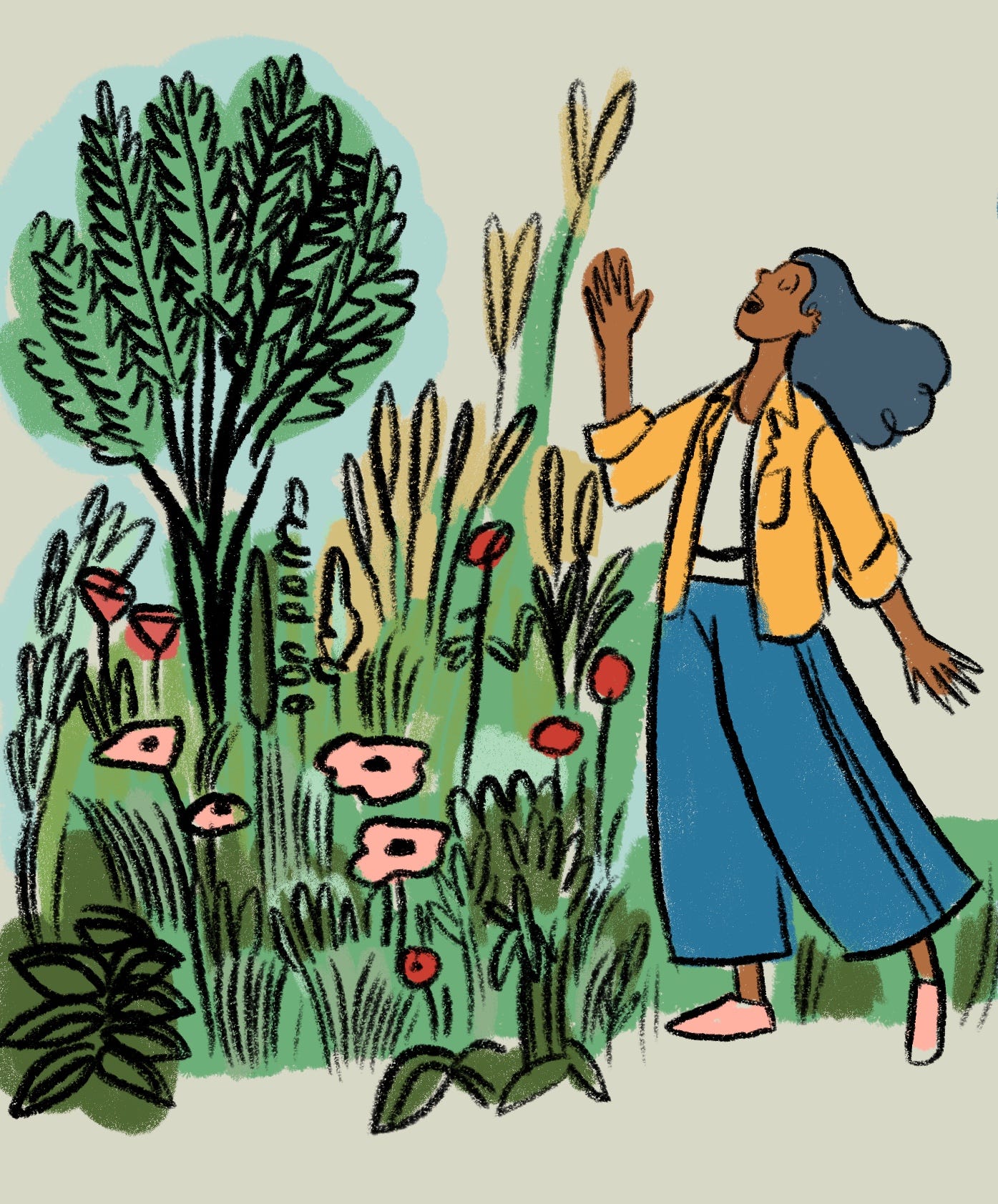
Written and Illustrated by Sophie Lucido Johnson
Office of Modern Composition is a Chicago-based writing studio that both makes compositions and fosters composers. We offer one-on-one coaching for writers and also take on commissions for things you need to have written. We also host free events like our in-person and online co-writes.